Retail and products
Product video ideas for small business: twelve buyer questions to answer
Turn product listings and customer questions into twelve useful clips: fit, compatibility, accessories, care and bundle prices.
If you sell pottery, jewelry, woodwork, candles or sewn goods, this guide turns one handmade piece into a week of useful videos. Start with your buyers' questions: Will this mug fit under my coffee machine? Is the initial included in the price? Can I collect it at the fair? You'll leave with a filming checklist, seven post ideas, a way to work out order deadlines and a sample brief for an invented pottery studio.
Choose one piece you can supply now. Fill these gaps before recording; a missing measurement or an outdated order date can make an otherwise useful post misleading.
Choose the questions you actually receive; this is not a daily posting obligation. Schedule fair and order reminders when their dates matter. Swap mug dimensions for ring sizing or board dimensions in your trade.
Film the mug beside a ruler, then under a coffee machine if it fits. Say its height and usable capacity. A drawn spec card can repeat those measurements, but keep the real shape visible in a separate shot so buyers can judge the handle.
Record one complete action, such as attaching and smoothing the handle. Say what you are checking: “I leave this space so fingers clear the hot cup.” Show your actual method rather than a sped-up sequence with no explanation; for jewelry, show a clasp check instead.
Use text cards, a mug outline and an initial to answer “What do I choose for someone who has everything?” Show the personalization option, its price and how to specify the letter. The Product hero template (Comic panel version) is an example brief and storyboard, not a promised app feature.
Film how you wash this mug and show the written care note that goes in the parcel. Use instructions you can support for your finished piece; do not infer dishwasher or microwave suitability from how a glaze looks. For a cutting board, demonstrate the care you actually recommend.
State whether the piece is ready to ship or made to order, what personalization includes and when orders close. Put dispatch estimates and any delivery conditions in the accompanying text. Offer a confirmed collection option rather than promising a carrier arrival date you cannot control.
Before the fair, post its date, venue, opening hours and stall number if assigned. On the day, film the entrance-to-stall route and show what is actually on your table. Say whether customers can collect an existing order there; remove the dated post from any ongoing promotion afterward.
With permission, pair a customer’s exact words with the item they reviewed. Do not extend a compliment about packaging into a claim about durability. The U.S. FTC rule prohibits fake testimonials and rewards conditional on positive or negative review sentiment; check the current rules for your market (FTC).
Use your own recordings for surface, finish and workmanship. Drawings can explain a dimension or deadline, but they are illustrations of the product, not evidence of its condition.
| Buyer question | Record the real piece | Explain with drawn graphics |
|---|---|---|
| How was it made? | Show a tool touching the piece and one finished detail. | Use a text label naming the operation; do not simulate a workshop. |
| Will it fit? | Place a ruler beside the item; show the handle or fastening. | Repeat confirmed measurements with dimension lines. |
| What does the price include? | Show the included personalization on a finished example. | State base price, optional charges and shipping separately. |
| When can I get it? | Show ready stock only if it is still available. | Distinguish order cut-off, dispatch estimate and collection date. |
| What will the finish look like? | Film texture and variations on the actual batch. | Do not use an idealized drawing as the finish reference. |
| Where can I collect it? | Show your stall or collection point. | Give venue, date, hours and collection instructions. |
Check the current rules for your marketplace and country; this is an editorial checklist, not legal advice. The U.S. FTC examples below concern U.S. claims, not a worldwide definition of handmade.
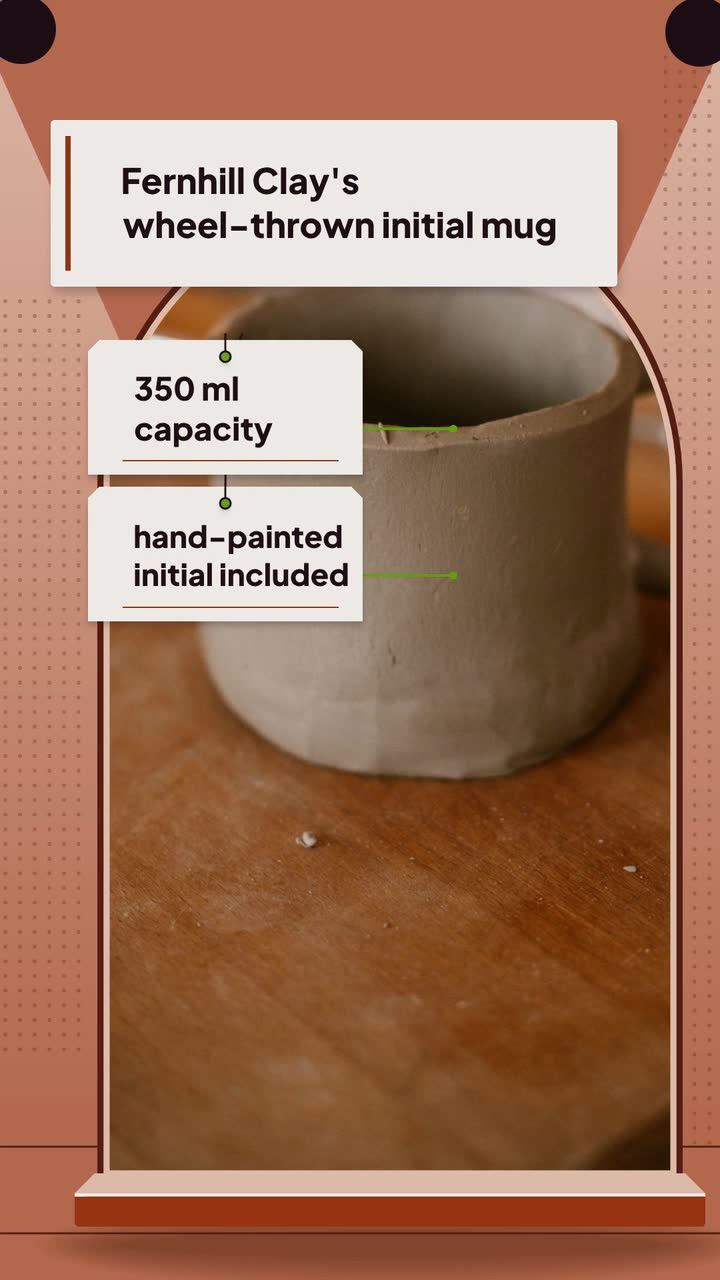
Fernhill Clay is an invented pottery studio. Its $38 mug includes one painted initial, holds 350 ml and is collected on November 28. The Product hero template (Spec sheet version) is an example brief and storyboard; the stock photo is not the studio's own mug.
Create a 15 s, 9:16 vertical video for Fernhill Clay's wheel-thrown initial mug. Price $38, including one hand-painted initial; capacity 350 ml. Use a stock photo of a handmade clay mug behind short text labels; it stands in for the mug, not a picture of it. Colors: #9a3412, #65a30d and #fdf6ec. No narration. Show the mug name first, then capacity and included initial, then price. Close with Fernhill Clay, Order by Nov 20, and Studio pickup Nov 28. The post's text will link to the shop's order page.
| When | On screen | Why |
|---|---|---|
| 0–3 s | A stock photo of a clay mug; “The initial mug” with “Fernhill Clay” above. | Identify the piece without pretending to show its real finish. |
| 3–7 s | Two labels over the photo: “350 ml” and “Hand-painted initial”. | Limit this beat to the capacity and the customization included. |
| 7–10 s | “$38” with “Initial included” beneath. | Make the offer understandable without a separate price calculation. |
| 10–15 s | “Fernhill Clay”, “Order by Nov 20”, “Studio pickup Nov 28”. | The business's close gives an order action and a collection date, without promising shipping arrival. |
| Outro | The ProcVideos outro closes the video. | |
Videos Creator is coming soon to Attain OS. Each generation differs because an AI model plans the video. If the dates are hard to read, regenerate with feedback asking for fewer labels and a longer closing hold.
Try a brief like this one
Videos Creator is coming to Attain OS. You can create your Attain OS account today.
Choose the event your buyers actually shop for: a local fair, a wedding order or a gift exchange. Do not assume a spring market or December rush fits every craft or location. Before that event, prepare reusable size and care posts, then add dated reminders only after you confirm your available stock and making capacity.
Work backwards from the customer's required date: allow for your queue, production, any drying or curing relevant to the piece, packing and the delivery estimate you currently use. Mark dispatch separately from arrival. If the margin is too uncertain, offer collection or stop taking that category of custom order. Your ready-made stock may still have a different deadline.
Keep a record of which posts led to questions about dimensions, personalization or collection. Use those questions for the next batch of videos instead of judging the plan only by views. For a gift-season schedule, use holiday promo video ideas; for other ways to explain one item, see product video ideas for small business.
Yes. Frame your hands, tools and the finished item. Choose a step that helps the buyer understand the piece, such as closing a clasp or checking a handle, and explain what you are doing in the post. Keep customer names and order paperwork outside the shot.
Film the finished mug for height, capacity or glaze variation; film a process step to explain your contribution. Label an older clip showing another batch so it is not mistaken for the piece currently offered.
Not necessarily. Etsy includes original designs produced in your own shop with computerized tools. Describe your process; the category does not mean made without machines. Check the current policy before listing; this is not legal advice ([Etsy](source:2)).
Set the cut-off from your current queue and the required collection or delivery date first. Announce it when you open that order window, then remind buyers while spaces remain. Once it closes, replace the call to order with the next available date or ready-made options; do not keep an expired offer running.
Etsy requires original photos or video of the finished seller-made product; the first image for a personalized item must show a finished customized example. Check the current policy ([Etsy](source:2)). Keep real images in the listing and use drawn clips on social to explain the offer.
Example templates
An example template is a sample brief and storyboard for one kind of video, in one style, format and length.
Rules and platform features change. Check the source before you rely on it.
Retail and products
Turn product listings and customer questions into twelve useful clips: fit, compatibility, accessories, care and bundle prices.
Retail and products
Plan the reveal, buying details and launch-day close, with a sample headphone brief and checks for pre-orders and creator samples.
Retail and products
Turn one linen shirt into a useful lookbook: a short storyboard, real fit evidence, six posting ideas and checks for fabric claims.
Retail and products
Texture demos, label questions and a serum storyboard for small skincare brands, with U.S. claim and creator-disclosure checks.
Tell the Attain OS team what you want to make.
Videos Creator is coming to Attain OS. You can create your Attain OS account today.