
Home services
Lawn care marketing video ideas, from route booking to leaf pickup
Fill a route, explain a rain delay or book leaf pickup: a seasonal video plan for lawn crews, with a worked cleanup brief.
If you run a small moving company, use these video ideas to explain what customers must tell you before you can price and schedule a job. You get a publishing checklist, eight subjects to film or illustrate, estimate wording and a worked brief. The regulatory examples concern U.S. interstate household-goods moves covered by federal rules. Check current rules with your regulator for your operation and location. This guide is not legal advice.
Review the video with its post, then alone: it may be shared without the caption. Check current rules for your operation; federal examples apply to covered U.S. interstate household-goods moves.
Try one subject each week. Put the estimate video on your quote page and send the access checklist with appointment confirmations. Answer one question per video and end with a specific next step.
Walk through a staged room, open the closet and mention the garage or storage unit. Include items needing disassembly or special handling. Say “Tell us about every pickup and delivery stop.” Describe your actual survey method, checking current federal survey and written-waiver rules if applicable (booklet). Send this before the survey appointment.
Contrast a binding estimate’s listed goods and services with a non-binding estimate’s weight-and-service calculation. For covered U.S. interstate collect-on-delivery moves, 110 percent is not a final-bill cap. Services requested after the contract and impracticable operations requiring extra equipment or labor may also be payable; the latter are limited at delivery to 15 percent of all other charges due (49 CFR 375.407). Check current rules; invite questions about payment at delivery.
Draw the route from the loading space to the apartment door, marking stairs, elevator and distance from the truck. Ask “Does your building require a reserved elevator or loading slot?” Explain who contacts building management and confirms parking. Use an invented plan without an address; post it with booking instructions.
Film your own blankets, hand truck, mattress protection and floor coverings, if you use them. Label each “included,” “optional charge” or “customer supplies,” and clarify whether packing is separate. For drawn graphics, the Service offer template (Checklist version) is an example brief and storyboard. Share the equipment video when discussing service inclusions.
Use your company’s actual acceptance policy. Ask about paint, fuel containers, plants and fragile or heavy items; do not present a universal prohibited-items list. Check current route restrictions before making legal statements. Refer customers to an appropriate service for items you cannot carry, rather than suggesting they hide them. Send this before packing.
Demonstrate a labelled essentials box with chargers, toiletries and bedding. Suggest keeping medication and important documents personally accessible. Label other boxes by destination room and contents, distinguishing fragile from heavy items. End with “Ask us what must be packed before arrival.” Share this with customers preparing their move.
Explain liability separately from blankets. For covered U.S. interstate moves, Released Value is no more than $0.60 per pound per article and requires a written waiver of Full Value Protection (booklet). Show the written options, charges and exclusions; check current rules. Publish alongside your estimate explanation.
Demonstrate a blank claims form: where to send the item description, inventory reference and supporting information. The federal booklet gives nine months to file a written loss/damage claim from delivery, or expected delivery if the entire shipment is lost (booklet). Check applicable current deadlines; send this with delivery guidance, without promising payment for every claim.
These U.S. interstate household-goods summaries are not contract clauses. Check current rules and your documents before adapting them. Keep the explanation legible beside each term.
| Term | What to explain | A line to adapt |
|---|---|---|
| Binding estimate | A set amount for the listed goods and services, with changes handled before loading (booklet). | “Let’s confirm the inventory and included services before loading.” |
| Non-binding estimate | Final charges depend on actual weight, services and the tariff; delivery payment has separate rules (booklet, delivery rule). | “Ask what is payable at delivery and what may be billed later.” |
| Physical survey | The mover sees the goods on-site or virtually; a written waiver is an exception (booklet). | “Show us the storage spaces as well as the main rooms.” |
| Full Value Protection | Repair, comparable replacement or payment for repair/replacement, subject to terms and exceptions; applies unless waived (booklet). | “Review the protection terms, charges and any deductible.” |
| Released Value | No extra charge, but no more than $0.60 per pound per article after a written waiver of Full Value Protection (booklet). | “This limited option is based on weight, not purchase price.” |
| Bill of lading | The shipment receipt and transportation contract (booklet). | “Read the service, dates and payment terms before signing.” |
FMCSA flags missing written estimates and demands for cash or large advance deposits (FMCSA). Check current rules before discussing legal duties. Explain your process rather than declaring your company “scam-proof.”
Two Rivers Moving is an invented local-only U.S. business. The Service offer template (Checklist version) is an example brief and storyboard. Before adapting it, add real advertising identifiers required under current rules; do not invent a registration number.
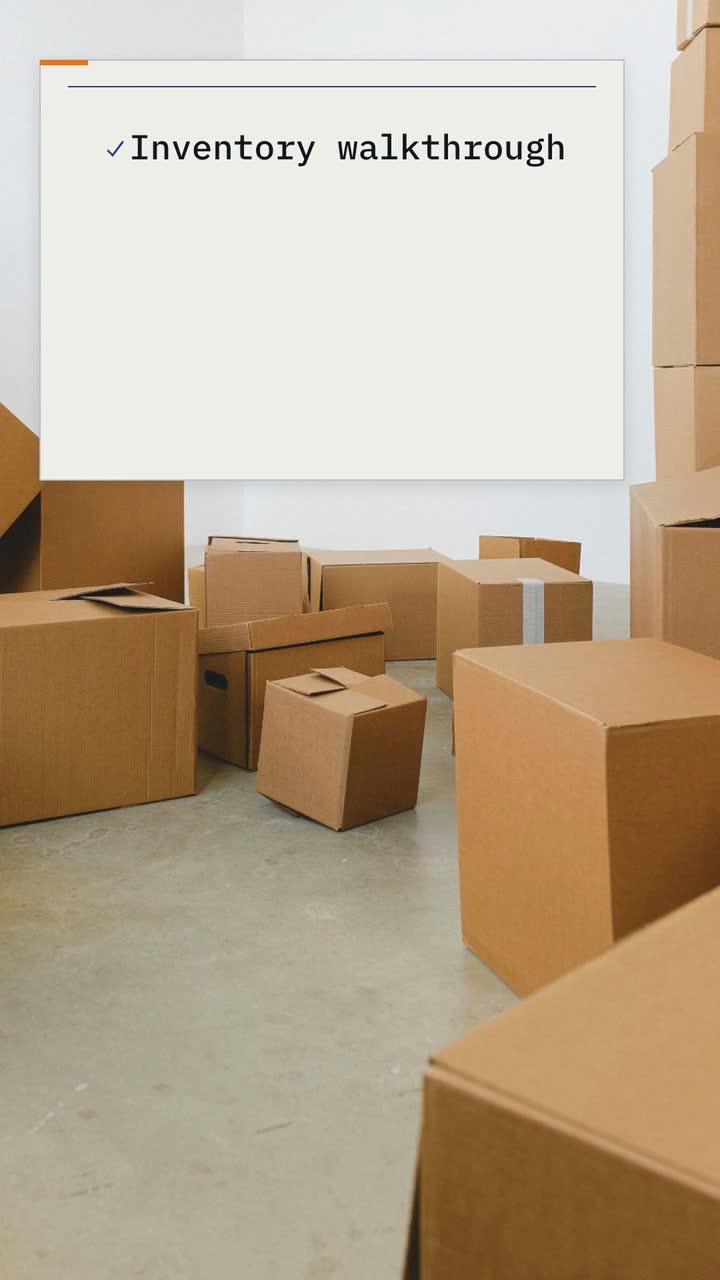
Create a 15 s vertical 9:16 video for Two Rivers Moving, local apartment moves. Use the type style, #1e3a8a navy, #f97316 orange and #fffbeb cream. Use a stock photo of moving boxes in an empty room behind the words, with checklist marks. Show “Apartment move?” then “Inventory walkthrough,” “Furniture blankets” and “Floor protection,” one at a time. These are included in our service. End with “Two Rivers Moving · Request an estimate.” Narration in English: “Apartment move? Two Rivers Moving includes an inventory walkthrough, furniture blankets and floor protection. Request an estimate.”
| When | On screen | Why |
|---|---|---|
| 0–3 s | “Apartment move?” over the stock photo of moving boxes. | Names the service without implying a filmed customer job. |
| 3–6 s | “Inventory walkthrough” with a checklist mark. | Makes the first inclusion easy to read. |
| 6–9 s | “Furniture blankets” with a checklist mark. | Shows a handling inclusion without making an insurance claim. |
| 9–12 s | “Floor protection” with a checklist mark. | Keeps the third inclusion separate from the closing line. |
| 12–15 s | “Two Rivers Moving · Request an estimate.” | The business’s own close asks for one next step. |
| Outro | The ProcVideos outro closes the video. | |
The brief is text only. AI plans the video and writes it as code, then it renders as motion graphics. Crew photos and job footage cannot be inputs. Each generation differs; review the inclusions and narration, then regenerate with feedback if needed. Narrated videos include an SRT file in the narration’s language. Videos Creator is coming soon to Attain OS. See writing a video brief.
Try a brief like this one
Videos Creator is coming to Attain OS. You can create your Attain OS account today.
Do not infer this from distance alone. The federal advertising rule sets identifiers for movers subject to it ([49 CFR 375.207](source:2)). Check the current requirements for your operation with your regulator, including local advertising rules. Use your assigned number, never an example number copied from a guide.
Put the unit and scope beside it: crew size, truck, minimum booking and the treatment of travel, stairs and materials. Use a separate explanation if those details will not fit legibly. Check current pricing rules with your adviser and keep the video consistent with your written estimate.
Use your actual acceptance policy and equipment capabilities, not another mover’s list. Confirm current route restrictions before advertising the service. Ask customers to identify these items during the estimate conversation and explain when a specialist needs to be contacted.
Ask for permission for the intended use before filming, and check current privacy requirements. Frame the handling task closely; keep addresses, documents, family photos and security details out of view. Stop filming if permission is withdrawn. A staged demonstration in your own space is another option.
Give your claims contact and describe the written submission process. For covered U.S. interstate loss/damage claims, the federal booklet states a nine-month period from delivery, or expected delivery for loss of the entire shipment ([booklet](source:1)). Check current rules; do not imply that a social-media comment replaces a written claim.
Example templates
An example template is a sample brief and storyboard for one kind of video, in one style, format and length.
Rules and platform features change. Check the source before you rely on it.
Home services
Fill a route, explain a rain delay or book leaf pickup: a seasonal video plan for lawn crews, with a worked cleanup brief.
Home services
Build a first-clean video for an invented company, then plan posts about recurring visits, deep cleans, move-outs and rental turnovers.

Home services
Turn ant calls, termite concerns and questions about the first visit into useful videos, with a local posting plan and careful treatment wording.

Home services
Turn questions about call-out fees, drain visits and water heater quotes into useful videos, with a cold-weather series for areas that freeze.
Tell the Attain OS team what you want to make.
Videos Creator is coming to Attain OS. You can create your Attain OS account today.